Hip
Hip Cup Insertion
Hip Stem Insertion
If you suffer from hip pain, stiffness or limited hip movement, schedule an appointment with Dr. Vincent Dalton to evaluate your condition and discuss all of your individual options, including nonsurgical treatment and hip replacement surgery.
Hip pain and its effects are unique for each patient and so is Dr. Dalton’s specialized treatment. Many patients may find a number of nonsurgical treatments – cortisone injections, bracing, physical therapy, or altering your exercise program- to recover or alleviate their hip pain.

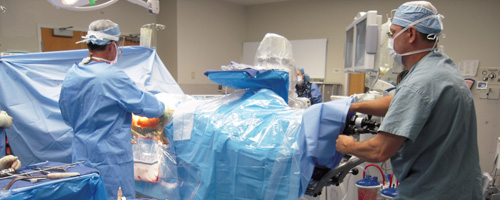
However, if you do require surgery, the anterior hip replacement procedure is the most advanced and minimally invasive surgical option. Dr. Dalton is one of only a few experienced orthopedic surgeons in Richmond, VA to offer the state-of-the-art hana® Table. The operating table allows him to minimize trauma with pinpoint positioning that conventional operating tables simply can’t offer. The result is a surgery that doesn’t affect the muscle tissue, providing instant hip stability afterward. Tasks such as climbing stairs, sitting down and tying a shoelace can once again be pain-free.
Anterior Hip Replacement
The anterior hip replacement procedure allows Dr. Dalton to reach the hip joint with a small incision on the front of the hip. Working through the natural separation between muscles, this advanced procedure doesn’t cut or detach any muscle from bone. Limiting the number of affected tissues, results in a speedier recovery.
Advantages of Anterior Hip Replacement:
- A small incision of 3 – 4 inches provides reduced scarring and less pain than traditional procedures, which require incisions of up to 10 inches.
- Shorter hospitalization: 2 – 4 days instead of 3 – 10 days.
- Shorter recovery time: 2 – 8 weeks instead of 2 – 4 months.
- Fewer restrictions during recovery, allowing the patient to move freely soon after surgery.
- Less risk of hip dislocation because key muscles are not disturbed.
- Increased ease for heavier patients because the incision is closer to the hip joint than traditional hip surgeries.

| Potential Advantages Include | Anterior Approach | Conventional Surgery | ||
| Average Hospital Stay | 2 to 4 days | 3 to 10 days | ||
| Smaller Incision | 4 to 5 inches | 10 to 12 inches | ||
| Less Muscle Trauma | No muscle detachment | Muscles cut from bone | ||
| Faster Recovery | 2 to 8 weeks | 2 to 4 months | ||
| Reduced Pain | Yes | |||
| Reduced Tissue Healing Required | Yes | |||
| Reduced Risk of Dislocation | Yes | |||
| More Accurate Leg Length Control | Yes | |||
| More Rapid Return to Normal Activities | Yes |